
The setup: one disc, one empty house
The Roblox listing states the premise itself, and the rest of the story only fills it in.
Mom's at work. Your uncle sent over an old TV game. Do what Suzy says... but ONLY when Suzy says.
A scary game of Simon Says with a horror story. October 2003: you're home alone, and Suzy wants to be your BEST friend. Follow her orders, don't get tricked, and hide before it finds you.
Three details from that text set up everything that follows. The game came from a relative who is not in the house. Mom is at work, so the house is yours alone for the night. And the date is fixed: one night in October 2003, played on a television of that era.
One piece of official artwork keeps the same framing. It shows a SUZY SAYS! box resting on a red armchair under a sunflower painting, with a thin black figure standing in the lit hallway behind it. The disc itself is not scenery: the secret route ends by breaking it.
Who Suzy is
Suzy is the host inside the television: a cartoon girl with orange hair, a purple dress and a rainbow backdrop. She is not a character you control. She talks, you answer with your body, and she narrates the result.
This is how we play. You just have to follow my instructions, but only when I say: "Susie says".
Her tone carries the story. She calls herself your best friend, praises a good round ("You're a natural at playing hide-and-seek.") and objects when you leave the script ("Susie says stop.").
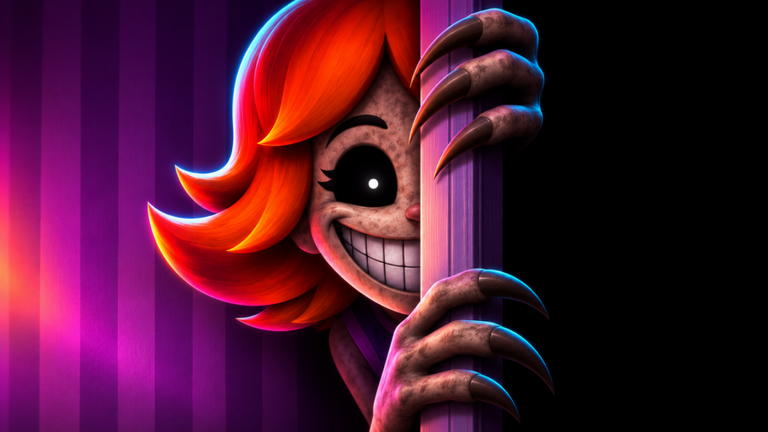
The artwork above is official promotional art from the Roblox listing, not a captured gameplay frame. It advertises a second version of her: the same orange hair and a wide grin, peering from behind a door frame with clawed hands. Nothing in the recorded dialogue says when or why that version appears.
What Suzy actually is — a recording, a ghost, something using the disc — is never stated in the material this site has read. The game gives her a screen, a voice and a game to play, and stops there.
The visitor, and the front door
The second threat never gets a name. Dialogue calls it our special friend, and the listing's own warning is "hide before it finds you".
A special friend wants to play too.
We have visitors. I wonder who that could be. Perhaps it is our special friend.
The front-door stage is where the story shows how it works. Suzy orders you to shut the door, then tells you the order was pointless in the same breath.
Susie says: Close the front door. It's a little cold out there.
It's already in your house. It's coming for you too.
The two lines arrive together in the transcript, so shutting the door and learning the bad news land at the same moment. The artwork shows what the dialogue will not name: a tall, thin, black, faceless figure with long clawed fingers, standing in a doorway while the player faces the television. No line in the recorded dialogue calls it a monster or explains where it came from.
How the rest of the night is told
The mat round teaches the rule, and the house errands turn the rooms into part of the game: the orders start naming objects you can see, such as the sunflower painting in the living room, the picture on the refrigerator and the rubber duck. After that the story moves through three beats, and almost every plot detail sits inside them.
The first beat is a phone call. It is the only moment the outside world reaches the house.
Hi, honey, just wanted to make sure you were okay. The connection seems to be bad. Can you hear me?
Suzy's answer to the call is a single line, and it treats the interruption as an annoyance.
Mom interrupted our fun.
The second beat is the hide-and-seek round. The order is a single word, and clearing the round is reported as a compliment from Suzy.
Susie says: Hide.
You're a natural at playing hide-and-seek. We couldn't find you anywhere.
The third beat is the one the ending cards hang on. She asks for candles, then for a look at a set of symbols, and the transcript places one more line right after it.
Susie says, bring me four candles. Everything will be fine after that.
Susie says: Look at these symbols.
I'm at home. Honey, where are you?
That last line reads like Mom arriving, and the caption set does not label who speaks it. It is also the reason the next section treats the two story cards as two cuts of the same finale.
The two ways the night ends
Story mode finishes on one of two cards rather than on a cutscene, so the ending you are given is also the only summary you get. A secondary guide describes both as the same finale cut two ways: Sweet Dreams closes on Suzy's sign-off, and Mom's Home cuts to Mom arriving, which fits the "I'm at home" line above.
Both cards are recorded after the same final stretch of commands. Whether a choice splits them, or the game picks one, is not confirmed by any source this site has read.
The secret route ends differently. Instead of collecting the four candles you take the colour code from the kitchen radio, enter it on the mat, and the objective becomes "Snap the DVD". The disc you were sent is the thing you break, and the card is Snap!, labelled the Secret DVD Ending in walkthroughs. The steps and the colour order are on the ending cards page.
What the story does not answer
- What Suzy is. No line explains whether she is a recording, a ghost or something else.
- What the visitor is. It is named only as "our special friend", and no line says where it came from.
- Whether the night is based on a real event. No official page makes that claim; the listing calls it a horror story set in October 2003. A Reddit thread titled "An analysis of the story behind the new horror game Suzy Says" ranks for these searches, and this site has not verified it.
- Whether the uncle is ever heard from. The description is the only place he is named in the material read here; no transcript line adds to him.
- Whether the two story cards split by choice. Recorded runs reach the same final commands for both names.
Where to read next
If the story is clear and the run is not, start with the first-run walkthrough, which turns the same phases into actions. If you already know the rule and only need a specific card, go to the six ending cards for the route and the trigger status of each one. If a guide you found describes three endings and a candle ritual you cannot reproduce, you are reading about the PC game with the same name.